
Market Research
We conducted thorough research on various financial platforms and categorized them into distinct sections based on their primary functions. The platforms were grouped under headers such as "Payment", "Investment", "Learning", and "Management". This structured approach helped us identify platforms that align with specific financial needs.

Name: Mihir Vyas
Age: 24 years
Education: Software Engineer
Location: Currently residing away from his hometown for his job (Mumbai)
Family Background: His family is involved in the software business.

Financial Background and Behavior:
Income: Mihir has a stable monthly income from his job as a software engineer, allowing him to cover his expenses comfortably.
Investment Experience: He has some experience with investments, including a few stocks, but he wants to explore more investment options.
Goals:
Mihir wants to earn a lot of money as quickly as possible
Mihir wants to buy his own house and car. He also has a dream to travel around the world.
Pain Points:
Navigating Investments: Mihir is unsure about how and where to start investing and seeks guidance.
Time Constraints: He has time constraints to figure out and check his finance regularly.
User Persona


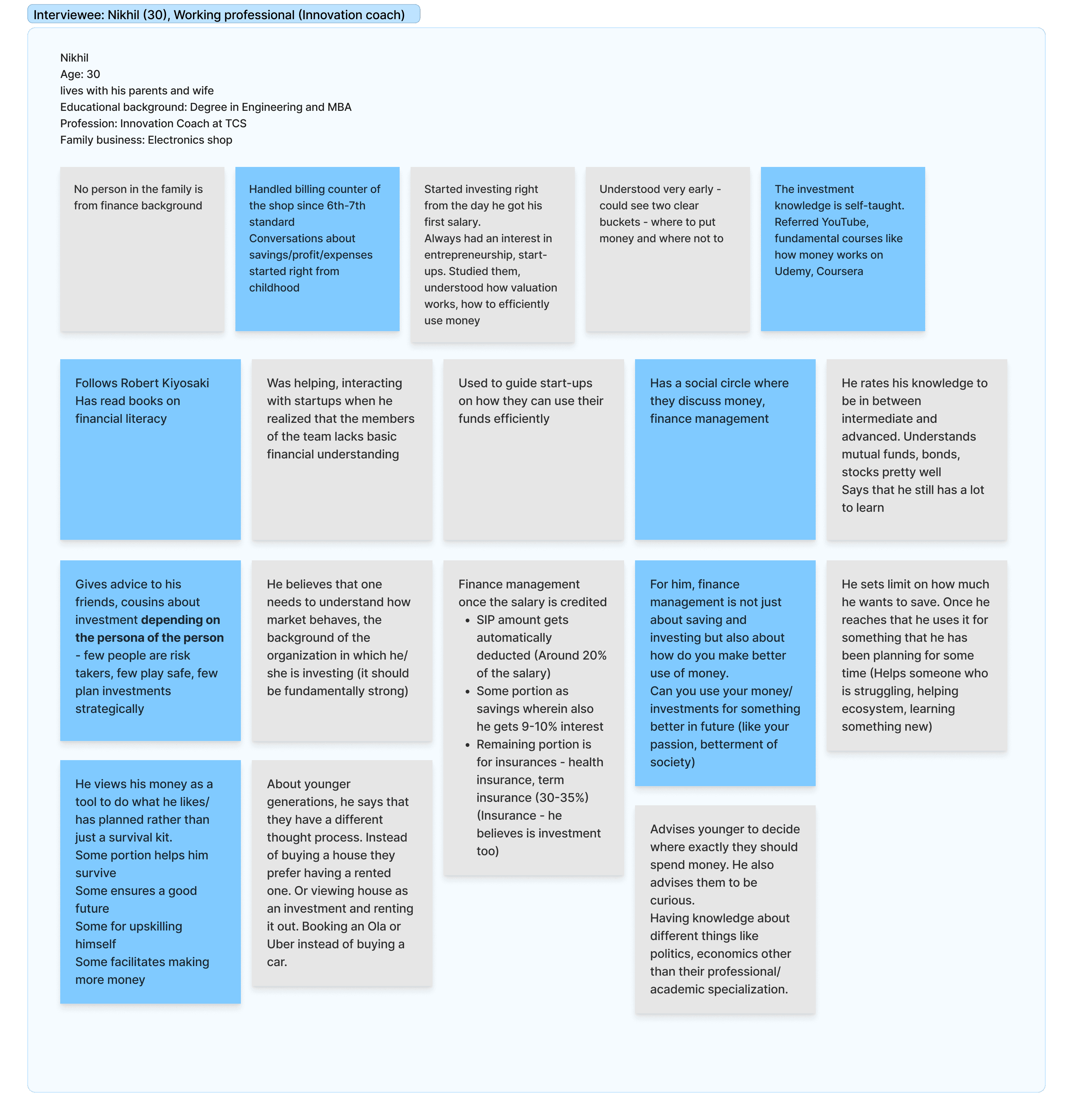


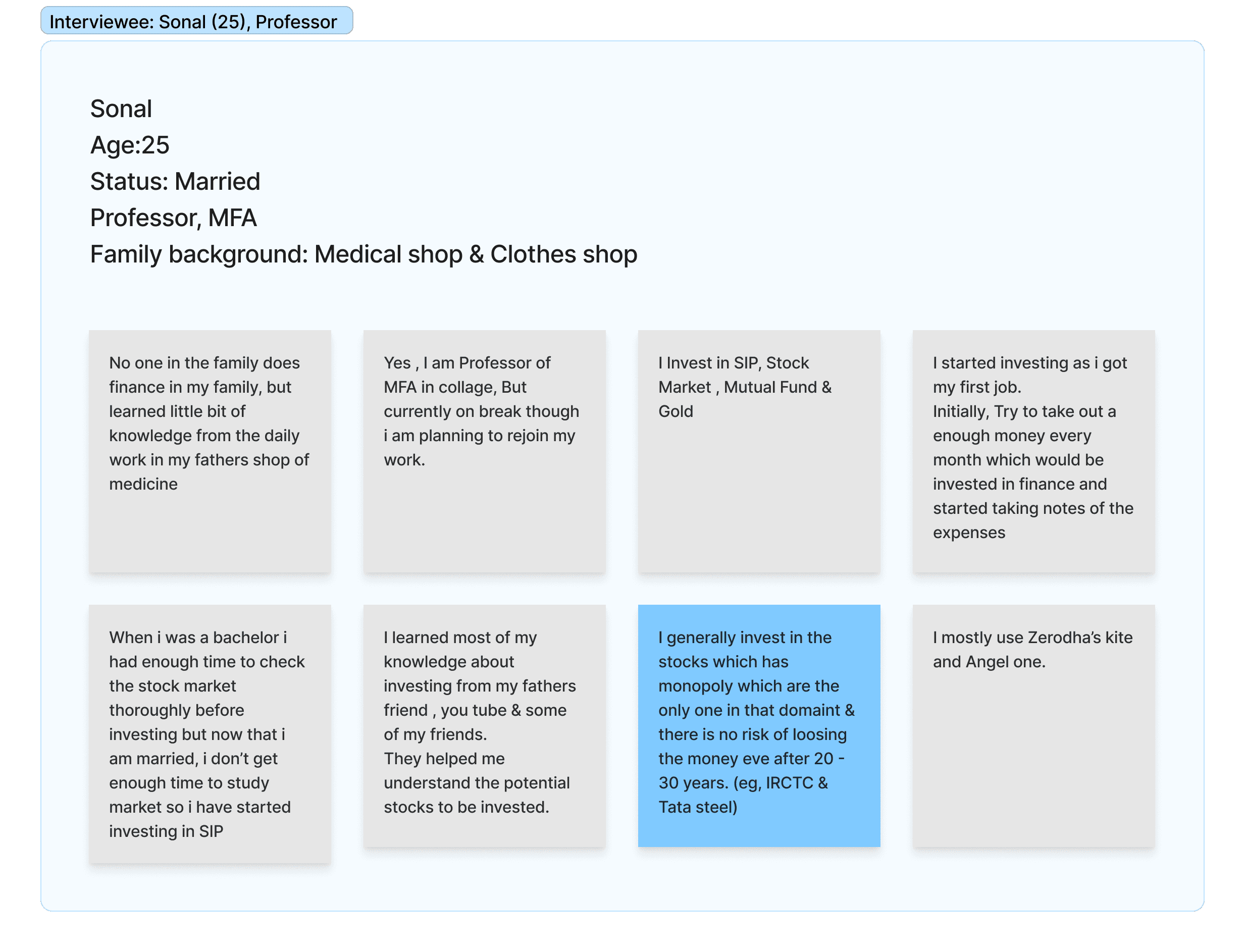

Unawareness/uninformed about one’s own wealth
Daily reading to keep up with the current affairs is missing.
Consultant is like a family doctor (as he considers demographics, family background, personality, risk tolerance etc), then gives advice.
The younger generation wants to earn a lot of money and that too quickly. But have no idea how much money do they realy want/need to fulfill their aspirations.
With growing inflation /uncertainties because of which they are unable to determine wealth / finances required for future
No savings for future/no considerations about future uncertainties
No clear financial goal
Having financial skills regardless of your profession/academic specialization is essential.
A person with a good educational background doesn’t imply that he/she is also financially educated.
Difficulty in personalization of experience/implementing the recommendations from learning resources such as YouTube.
Key Insights from the Interviews

Learn. Budget. Thrive.
Goalify
Young adults, aged 18-25, who may be new to managing their own finances and are looking for guidance on core financial principles.
Target Audience
Team
Mrunmayee Kenge, Prachi Joshi, Saloni Chaudhary
Tools
Figma
Timeline
4 weeks

High fidelity wireframes
Sign Up
Users can securely log in to access their financial data, track expenses, set goals, and make informed decisions. also ensuring a smooth and secure start to their financial journey.


Home page
Our Home Page offers a comprehensive financial overview at your fingertips. It's the central hub for your financial journey, empowering you with real-time data and tools to achieve your financial goals and make well-informed decisions.

The Aspiration Board is where dreams and financial goals come to life. Here, you can add, organize, and prioritize your short-term and long-term aspirations. Visualize your path to success and track your progress.


You can set the name, description, timeline, and financial targets for your dreams. It's the place to add the vital details that will guide your financial planning and keep you motivated on your journey to achieving your goals

Fill in aspiration details
Visualize the path to achieving your financial dreams with a clear and organized timeline. Tracking your progress becomes a breeze as you break down your long-term and short-term goals into manageable segments, ensuring that you stay on course and remain motivated throughout your financial journey.
Dream Car
Aspiration board
Fill in aspiration details

This project reinforced the importance of user-centered design in making financial literacy accessible for young adults. Through research, iterative design, and user feedback, we crafted a tool that simplifies complex financial concepts and engages users.
Key Takeaways:
Audience-Centric Design
Understanding young adults’ challenges with financial concepts led to a simplified, visually engaging design that fosters better engagement.Iterative Process Enhances Usability
Regular testing allowed us to refine the user experience, ensuring clarity and ease of use.Consistency Through Design Systems
Implementing a design system kept the platform consistent and scalable, supporting future growth.Empowering Users for Lasting Impact
Our goal was to empower users to make confident financial decisions, and early feedback suggests positive, lasting effects.
Final Reflection: This project not only improved my understanding of user-centered design but also highlighted the role of empathy and research in addressing real-world challenges. Tackling a complex issue like financial literacy required a thoughtful approach and a commitment to simplifying without oversimplifying.
Conclusion
Flow model
This model outlines the overall steps users take when managing their finances and focuses on the communication between different users. It tracks the flow of activities, from setting financial goals to making decisions on saving, spending, or investing. It helps identify where users might experience confusion, delays, or unnecessary steps in their financial decision-making process.

Cultural model
Ideation
We brainstormed ideas using two "How might we" questions: one focused on improving the process of financial learning, and the other on practical ways to implement financial knowledge.
How might we make the process of financial learning better for young adults?
Simulation of real life situations in which finance is involved
A platform where a parent and a child will learn together
Guide to Useful Financial Apps for Effective Money Management
Integrating finance in academic curriculum
Find a Tutor
Personalized One-to-One Finance Learning Platform
Teaching practical implementation of Maths
Gamification to learn fundamentals of finance better
A channel which would inspire teenagers to start investing early
How might we help young adults practically implement their financial knowledge?
Financial Goal Tracker
Salary management app
Crash course which gives you daily/weekly task to upskill you (experience facilitation)
Investment strategies/recommendations depending upon the nature and need of the person
Peer sharing platforms (Finance katta) - (Data monetization - Selling the data to finance companies/lifestyle products)
App which gives personalized recommendations
An app designed for individuals to input their long/short-term aspirations, whether it be education, buying home, or retirement, and receive a quantified plan. It prompts users to assess their current financial standing, factoring in personal demographics and preferences, and subsequently generates a tailored roadmap to attain their aspirations, providing valuable financial recommendations.
Final Concept
One-to-one learning platform
An app where a novice can find a person with good financial knowledge.
2
3
1
For novice
For expert
Gamified learning platform
Give users a scenario of financial management where a person is in a crisis and they are supposed to get him/her out of it.
Guide for useful finance apps
An app designed to provide tutorials and insights into the functionality of various finance apps.
Personalized Learning
Flexible Scheduling
Diverse learning options
Engaging Learning
Practical Learning
Interactive problem Solving
Progressive Learning
Realistic Learning
Quality Control
User Dependency
Content Maintenance
Balancing education & Gamification
App Updates
App Accuracy
User Engagement
Ease of Use
Variety of Finance Apps
User Reviews
Pros
Cons
Concepts
Pros
Cons
Pros
Cons
Cost
Limited Availability
Quality Assurance
Information Architecture

This model examines the role of cultural norms, family expectations, and societal values in shaping users' financial attitudes and behaviors. It helps reveal how factors like upbringing, traditions, and social influences impact decisions related to saving, spending, and investing.

Primary Research
We conducted 10 interviews which included our target group - young adults (students and working professionals) from different educational and professional backgrounds such as engineering, commerce, website design, innovation & entrepreneurship. We also interviewed a financial consultant.
In India’s evolving financial landscape, young adults are moving from dependence to independence, highlighting the growing need for financial literacy. While they aspire to goals such as higher education, homeownership, and retirement planning, navigating these can be challenging. Providing practical financial tools is crucial to help them confidently achieve their goals.
- Many young adults enter adulthood without a solid foundation in financial education.
- Key aspects of financial literacy include knowing how to create a budget, plan for retirement, manage debt, and track personal spending.
- Young adults are more susceptible to financial threats because of less experience in the financial domain and are unable to start saving at an early age, which hampers their future savings accumulation.
Introduction
Financial literacy is essential for young adults as they begin to navigate their personal finances, yet many lack the knowledge and tools to make informed financial decisions. This project explores user-centered design methods to create an accessible and engaging experience that helps young adults build critical financial skills. By simplifying complex financial concepts, the project aims to increase confidence in budgeting, saving, and investing.
Project Overview

Kano's Model - Feature mapping